
Something Is Shifting Inside These Walls. I’m Not Sure What to Make of It.

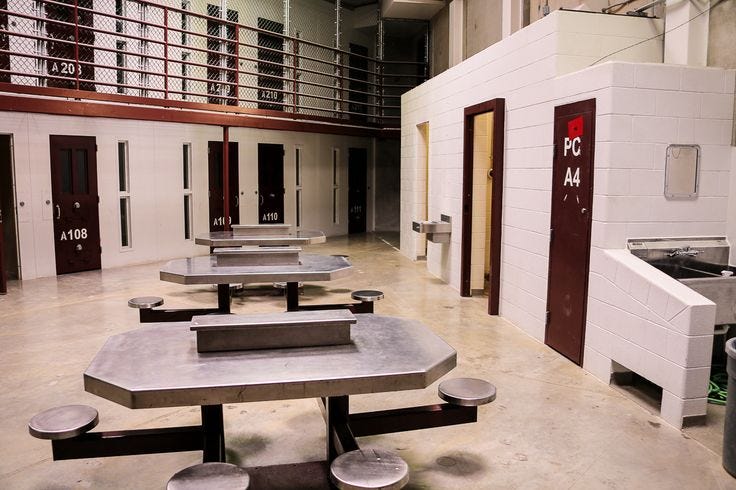
A few of the guys were watching the Knicks beat up on the Atlanta Hawks when a new officer came through the front gate. I’ll call him D. He locked the gate behind him and took his post in the far corner of the room. My friend Butta leaned over. “I don’t care what nobody says,” he whispered, “he’s CIA.” We laughed. D didn’t move. He just sat there, staring at the wall.
After a while, he got up and came over to watch the game with us. I decided to break the ice by telling him there was a rumor going around that he used to work for the CIA. He laughed, genuinely. It wasn’t the kind of laugh an officer gives when he’s managing a situation or weighing whether he’s dealing with someone who has an ulterior motive. Then, oddly, he started speaking freely.
He went on to tell me how, for fifteen years, he taught in a BOCES program for children with severe autism. He has a master’s in special education and had recently been overlooked for a promotion in favor of someone twenty years younger with half his experience. Upset, he complained to the school, causing things to spiral, and eventually resigned from a job he loved. Then he took a job with DOCCS.
He talked to me like I was a person.
After almost twelve years inside, I had to remind myself to respond casually — the way you respond to another human being simply having a conversation with you. Honestly, the fact that I had to remind myself at all should tell you something about what this place does to you.
I kept my voice loud enough for everyone around me to hear. This is something you can only understand if you’ve done time.
When I first came to prison, I quickly learned that conversation is not always just conversation. It is a risk. The first facility I entered was Clinton Correctional in Dannemora, a maximum-security prison with a reputation for extreme violence. An old-timer named Chico pulled me aside not long after I arrived. He explained the rules in a way that left no room for confusion.
If I wanted to survive, I was not to speak to an officer alone. Not casually. Not in passing. Not about anything. If I had to exchange words with a CO, I made sure someone was close enough to hear. If paperwork moved between me and an officer, I showed someone else first.
He explained that keeping my distance wasn’t disrespect. It was part of my survival.
In prison, perception travels faster than truth. Once a story is attached to your name, it doesn’t matter whether that story is accurate. What matters is that people believe it. I understood those rules immediately. Most men I came up with did. Not because someone forced us to, but because we witnessed firsthand what happened to the ones who didn’t.
Over time, those rules became something deeper than instruction. They became ingrained in our minds and part of how we lived. What Chico gave me wasn’t just advice. It was a form of orientation — a set of principles that have been passed down through decades of incarcerated men navigating an institution designed, at its core, to be navigated against them. He didn’t invent those principles, but like me, he inherited them. Then he passed them along.
For a long time, that transference held.
The younger men coming in today are not receiving what Chico gave me. Part of that is structural. The old-timers are tired. After years of watching their guidance go ignored, after years of younger men arriving too angry or too distracted to be reached, a lot of them now lay dormant. They do their time and wait to see if they live to make it home. The informal curriculum that once moved through these facilities — the one that told you where the lines were and why they existed — began to fade.
In its absence, the population became harder to read. Not because these young men are worse, but because nobody is sitting them down and having the uncomfortable conversations they need to hear.
None of this is happening in isolation. The deaths of Robert Brooks and Messiah Nantwi put New York’s prison system under scrutiny it hasn’t faced in quite the same way before. From the inside, those deaths were not a revelation, as mainstream media often depicts them. They were confirmation — documentation of what incarcerated people have been saying for years without being taken seriously.
A report released by Julia Salazar described the violence inside the state’s correctional facilities as endemic, not the product of individual misconduct but embedded in the structure of the system itself.
For those of us living here, that word didn’t feel like news. It felt like a necessary recognition.
Then, last year, came the officer strike.
What followed was difficult in ways that are worth being honest about. Programs were suspended. Movement was essentially locked down. Visits were cut back. The already constrained life inside these walls became even more constrained. But something else happened at the same time. A significant portion of the existing officer corps left — retired, transferred, fired, or simply did not come back. Into that absence, new officers began to arrive.
Some were younger. Some came from backgrounds that had nothing to do with law enforcement. Teachers. Counselors. People trained in de-escalation. People trained in how to be present with someone who is struggling without making it worse.
Officer D is one of those people.
The shift was not announced. There was no policy, no memo, no formal acknowledgment that something was changing. But you can feel it if you’ve been inside long enough to know what the old culture felt like. Some facilities — Upstate, Marcy, Coxsackie — still feel largely unchanged. The same rigidity. A similar distance. The same unspoken rules enforced the way they’ve always been enforced.
But in other places, the edges are beginning to soften.
The old culture inside these walls was brutal. But it was predictable. You knew where the lines were. You knew which interactions were safe and which ones would cost you. There is a kind of stability in that knowledge, even when it costs you everything else.
What’s emerging now doesn’t offer that same clarity. The environment is less consistent — which sounds like progress, and maybe in some ways it is. But inconsistency carries its own risks in a place like this. You can’t always tell which officer will meet your openness with openness and which one will mistake it for something else entirely.
By the time D went back to his post, the game was still playing. The room felt largely the same. Butta made another joke, and the moment passed the way most moments do in here — without announcement and without significance.
But I kept the witnesses.
Even while we were laughing, even while the conversation felt easy, I made sure people were close enough to hear every word. Not because I thought D was a threat, but because I am still the person Chico made me. The rules live in my body now. They shape the way I move, the distance I keep, the calculations I run before I speak to anyone in a uniform.
Something is shifting inside these walls. I believe that. I’m watching it happen in real time, from a vantage point most people writing about it don’t have. Whether what’s shifting will become something durable — a genuine change in the culture of this institution — or whether the system will return to what it has always been, I cannot say.
But I can tell the difference.
And I’m still figuring out what it means.
I was immediately gripped by this story, wanting to know about this new type of CO. Rushing back to me came conversations with my friend at visits about how we should/shouldn't speak, even in the family room -- and how my presence could help him from seeming gay (which, rightly so, I had worried would make life hell for him even though he wasn't - as you say, perceptions trump reality). In your story, I wanted to see what happens with this new, mysterious and personable CO. I am seeing so many articles flood the NY media about the mess in NY prisons -- and its escalation since December 2024 (miraculously exploding mere days after I went to pick up my friend from MidState after life inside for 2.5 years). As you so eloquently point out -- tell us something we don't know about the violence in prison! But, then, what outside folks also don't know about prison is how so many small things are powerful. And, in prison, a small detail (more than a big law change) can ripple into huge waves. This line sums up a lot: "The shift was not announced. There was no policy, no memo, no formal acknowledgment that something was changing. But you can feel it if you’ve been inside long enough to know..." Great piece.
I continue to pray for your safety. Your writing is important.