
When Shelters Close, Prisons Absorb the Fallout
Mayor Mamdani says the 30th Street Shelter is beyond saving. But prisons already overwhelmed by mental illness, addiction, and instability may soon inherit the fallout.

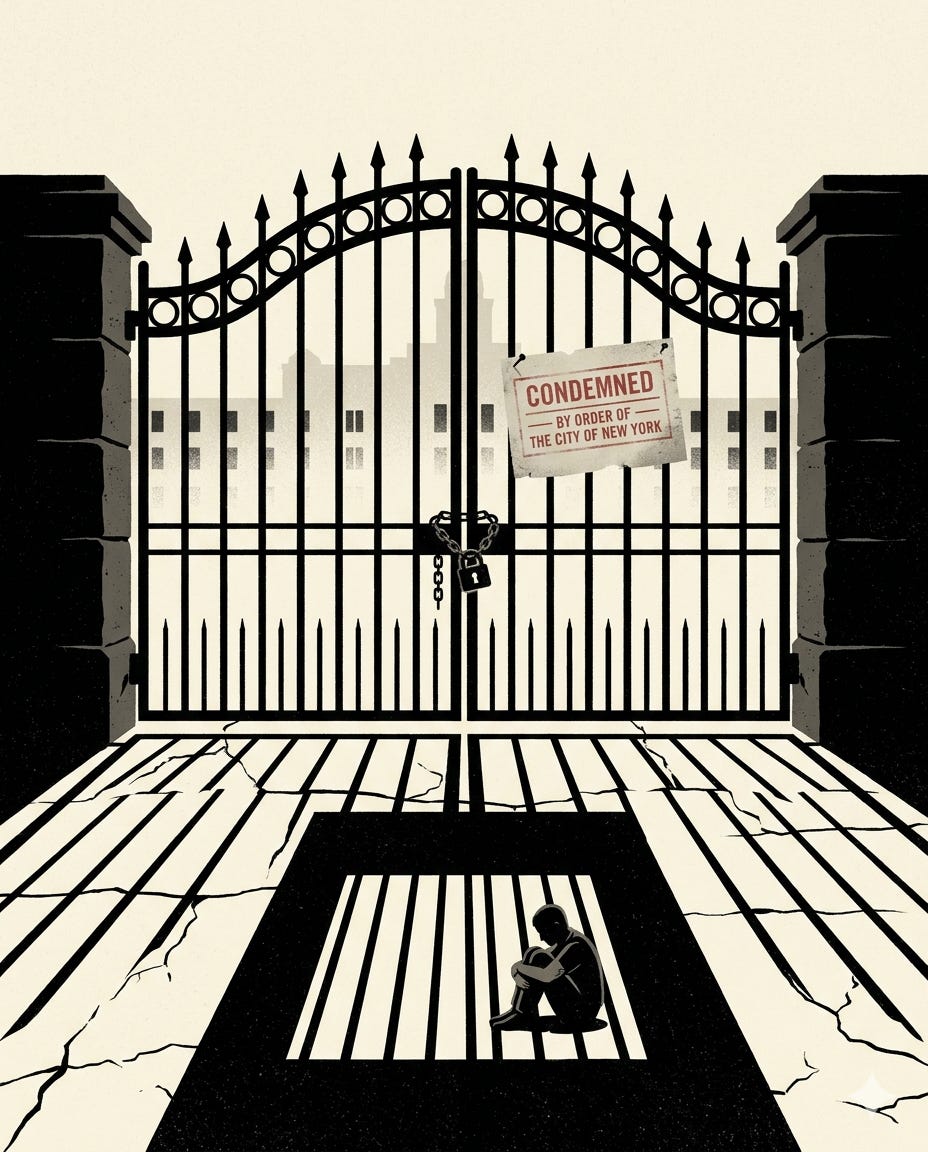
A few weeks ago, I was sitting in on a professional communication workshop led by volunteers from an outside organization. Somewhere during the conversation, the volunteer leading it mentioned that New York City was planning to close the 30th Street Shelter near Bellevue Hospital, the massive intake shelter that has served as one of the main entry points into the city’s homeless system for decades.
Most of the guys in the room barely reacted.
Honestly, I understood why. Many of the men sitting in that class have spent most of their lives bouncing between instability and incarceration. They’ve cycled through shelters, addiction treatment, county jails, prison, temporary housing, release, rearrest, and then another prison sentence. After a while, hearing about another institution shutting down or another system failing just starts sounding like the same old dance.
But I couldn’t stop thinking about it.
As somebody who has lived through these failures firsthand and who believes deeply in mental health treatment, addiction recovery, and long-term support, I kept wondering what was going to happen to the people who depended on that shelter. What happens to the people already hanging on by a thread? What kind of effect does something like this have on the city itself?
Then another thought hit me, one I couldn’t shake.
In the next couple of years, how many of the people who could have walked through the doors of that shelter will eventually end up walking past me in the hallways of a New York State prison?
Closing one of New York City’s largest intake shelters affects far more than homelessness alone. It sounds an alarm about what happens when systems that are already fragile begin collapsing into one another. After spending nearly twelve years incarcerated, I’ve come to understand that prison increasingly functions as the institution that absorbs the people every other system failed first, people struggling with untreated mental illness, addiction, homelessness, trauma, and long-term instability.
And at a moment when New York’s prisons are already strained by staffing shortages, deteriorating conditions, and growing mental health crises, it feels dangerously shortsighted to destabilize one of the city’s primary intake shelters without confronting what happens to the people left with nowhere stable to go.
I’ve been incarcerated since I was nineteen years old. During that time, I’ve listened to countless comrades explain how they ended up here. Very few of their stories actually begin with incarceration.
They begin with untreated mental illness. Addiction. Childhood trauma. Homelessness. Family instability. Years spent drifting between shelters, the couches of family and friends, subway stations, psych wards, county jails, and now prison.
By the time a lot of people end up incarcerated, they’re already carrying years of unresolved struggle.
After that workshop, my wife and I started researching the relationship between homelessness, housing instability, and incarceration. Some of the numbers we found through the Osborne Association and other organizations honestly gave me goosebumps.
Formerly incarcerated people are nearly ten times more likely to experience homelessness or unstable housing. People experiencing homelessness are eleven times more likely to be arrested than the general public. Close to half of the people returning from New York State prisons eventually end up in the New York City shelter system.
When people experiencing homelessness are already exponentially more likely to encounter the criminal legal system, it’s hard to imagine how closing one of the city’s largest intake shelters wouldn’t intensify that vulnerability.
And from where I’m sitting, inside a prison system that’s already struggling, that possibility doesn’t feel far-fetched at all.
The history of the 30th Street building says a lot by itself. When it first opened back in the 1930s, it operated as Bellevue Hospital’s psychiatric facility. Later, after large psychiatric institutions started disappearing across the country, the building became a homeless shelter and intake center.
Now it’s closing at a time when New York is already contending with rising street homelessness, untreated mental illness, addiction, and public instability.
And underneath all those systems sits another institution absorbing many of the people who continue falling through the cracks above it. Prison.
To be clear, I’m not claiming that homelessness automatically leads to criminal behavior. And I’m definitely not saying people experiencing homelessness should be viewed as threats. Too many conversations already strip people of their humanity instead of recognizing the complexity of what they’re dealing with.
But I do think it’s impossible to completely separate incarceration from the failures happening across surrounding systems.
Prison often becomes the place people end up after every earlier intervention either failed, fell apart, or arrived too late.
What worries me most is that New York’s prison system is already fractured itself.
Over the last few years, everybody from corrections officers to prison administrators to state officials has publicly acknowledged that the system is in trouble. Facilities across New York are dealing with staffing shortages, interrupted programming, violence, burnout, and growing mental health crises behind the walls. Some prisons feel like they’re operating in a constant state of strain.
And despite all that, prison continues functioning as one of the state’s largest fallback systems for people dealing with untreated instability somewhere else.
The reality is uncomfortable and sadly true.
Addiction doesn’t disappear in prison. Mental illness doesn’t disappear in prison. Trauma doesn’t disappear in prison.
A lot of times, those things only get worse.
Every day, I watch men psychologically deteriorate. I watch people who clearly need serious treatment struggling just to survive inside an institution stretched far beyond what it was ever built to handle. I watch men leave prison carrying the same unresolved problems they entered with, except now those problems are compounded by years of incarceration and institutionalization.
That’s why the closure of the 30th Street Shelter feels like much more than one building shutting down.
To me, it reflects a larger pattern in this country, one where we wait until people are already in full-blown crisis before we intervene.
We respond after somebody’s sleeping on the subway. After an overdose. After a psychiatric episode in public. After an arrest. After jail. After prison.
Rarely do we respond before.
At the same time, New York is investing billions into mental health programs, supportive housing initiatives, outreach teams, and crisis-response systems. Some of those investments are important and long overdue. But there’s still a massive difference between a system designed to stabilize people and one designed mostly to manage visible crisis.
Too often, we’ve built the second kind.
New York City now spends roughly $81,000 annually per shelter bed. Supportive housing costs significantly less. Incarceration at Rikers Island costs more than $400,000 per person every year.
We spend enormous amounts of money reacting to instability once it becomes visible enough to disrupt public life. Meanwhile, the systems capable of creating real long-term stability before crisis happens remain fragmented, overwhelmed, or too small to meet the actual demand.
And now one of the largest intake shelters in the biggest city in the country is shutting down while every surrounding institution is already under pressure.
That should concern everybody, regardless of politics, background, or social class.
Because people don’t simply disappear when shelters close. Mental illness doesn’t disappear. Addiction doesn’t disappear. Trauma doesn’t disappear either.
Those problems move elsewhere. Sometimes into emergency rooms. Sometimes into subway systems. And sometimes into county jails or prisons already straining to function as they are.
But if New York is serious about interrupting this cycle, then the conversation cannot end with simply relocating people from one shelter to another or expanding crisis-response systems after somebody has already reached their breaking point. The state has to invest more aggressively in the kinds of systems proven to create long-term stability before people ever reach prison in the first place, giving them a genuine bridge back into society instead of another temporary stop along the way.
Organizations like the Osborne Association have already shown what that can look like through supportive and reentry housing initiatives designed specifically for people returning from incarceration. The problem is not that solutions don’t exist. It’s that the supports capable of producing that stability remain under-resourced and disconnected from one another while prisons continue operating as society’s fallback institutions.
Most people don’t suddenly appear in prison without warning signs long beforehand. By the time somebody reaches incarceration, multiple systems have often already failed them at once. If New York wants to reduce homelessness, improve public safety, lower incarceration rates, and ease pressure on an already strained prison system, then it has to stop treating housing, mental health, addiction, and incarceration as separate conversations.
Because prison was never designed to shoulder the weight of every other institution collapsing around it. And the longer we continue relying on it to do so, the more people we will lose inside systems that were never built to heal them in the first place.
And, another dimension to this problem is that there is an added factor ito it: the private for-profit prison industry, who will now step in to "fill that gap," while PROMISING to provide necessary services at a substantial cost-savings (which will inevitably be proven to be a lie), but which will provide even LESS service but will make a much-higher profit.
This is such an important perspective because it reminds us that incarceration rarely begins with crime… it often begins with unmet needs, untreated trauma, unstable housing, addiction or mental illness that went unaddressed for years. Your point that “people don’t simply disappear when shelters close” is one policymakers and communities alike should wrestle with.
A society that waits until crisis becomes visible has already waited too long. Prevention will always be more humane and ultimately more effective than punishment. Thank you for sharing your lived experience and challenging us to see these systems as interconnected rather than isolated. Real public safety is built through stability, dignity and opportunity, not just reaction.